
Tommaso Piazza

Università di Pavia

Mini-Curso sobre Evidencialismo

1ª Sessão: 23 Maio 2017, 14:00-16:00, sala Mattos Romão, Faculdade de Letras

Internismo, Externismo e Evidencialismo


2ª Sessão: 25 Maio 2017, 14:00-16:00, cave F1, Faculdade de Letras

O Evidencialismo Esquadrinhado

<Resumo das Sessões>

ENTRADA LIVRE

Claudine Tiercelin

Collège de France / Institut Jean Nicod

Are Skills Dispositions to Know?

12 May 2017, 16:00

Sala Van Gogh (Sana Executive)

Av. Conde de Valbom 56, 10º andar

Abstract: In a common attempt to lend proper significance to the concept of skill in philosophy and, possibly, to confort their own intellectualist analysis of know how in terms of propositional knowledge heavily relying on the concept of practical modes of presentation, Stanley and Williamson have recently argued that skills should be taken more into account and should be viewed, basically, as dispositions to know. Although I agree with many aspects of their analyses, think they offer rather convincing replies to some anti-intellectualist objections, and provide a better view of skills than other suggestions that have been made, e.g. in terms of competences or in viewing ‘practical modes of presentation’ as Fregean ‘practical senses’, I shall underline some difficulties in their position and suggest some ways of solving them, as far as three major issues are concerned: by paying more attention to some important logical and metaphysical difficulties related to the concept of disposition itself;  by drawing – especially if one favors an intellectualist standpoint – a more careful distinction between skills and intellectual virtues (something we learnt from both Aristotle and Ryle);  by introducing some changes not so much to our concept of know how as to our concept of propositional knowledge itself.

Fiora Salis

London School of Economics and Political Science

Of Predators and Prey, or How to Fictionally Modelling Reality

5 May 2017, 16:00

Faculdade de Letras de Lisboa

Sala Mattos Romão (Departamento de Filosofia)

Abstract: Models represent. But how do they do it? In this paper I assess the two main fictionalist accounts of models as representations, indirect fictionalism and direct fictionalism, and develop a novel proposal, what I call simple fictionalism, by drawing on Walton’s theory of make-believe. Simple fictionalism offers an explanation of the nature of models from which several implications for an explanation of how they represent follow. The key to understanding how models represent resides in the idea that the representation relation between models and the world is a kind of indirect referential relation that is mediated by the imagination.

Christopher Belshaw

University of York

Procreative Beneficence and Procreative Asymmetry: Some Tensions

28 April 2017, 16:00

Faculdade de Letras de Lisboa

Sala Mattos Romão (Departamento de Filosofia)

Abstract: Procreative Beneficence (PB) is the view that we should select the best of two possible children, or the best of two future populations. Procreative Asymmetry (PA) is the view that though there is an obligation not to start bad lives, there is no obligation to start good lives.

PB can seem plausible. See, for example, Savulescu and Parfit. PA similarly can seem plausible. See, for example, McMahan. But, I argue, these two views are in tension. If we should start the best of two lives, when starting either is possible, then, contra PA, we should start good lives, when that is possible. Conversely, if there isn’t an obligation to start good lives, then, contra PB, there isn’t an obligation to start the best of two lives.

Which of these views is the more secure? PB, I argue, has several flaws. PA, in contrast, can withstand various objections (concerning its squaring with intuitions, its coherence, its lack of a rationale) that are made against it. We should prefer it to PB.

Lançamento do livro de Paulo Borges, “Do Vazio ao Cais Absoluto ou Fernando Pessoa entre Oriente e Ocidente”, 27 de Abril, 18:30

Neste novo livro dedicado a Fernando Pessoa, no qual continuamos a explorar a fecundidade filosófica da sua obra e a pensar a partir dela, reunimos estudos sobre as relações explícitas e implícitas do poeta e pensador português com temas centrais da espiritualidade e da cultura orientais e ocidentais. Dotado de um espírito cosmopolita e universalista, Pessoa dialoga directa e indirectamente com as grandes questões do pensamento e da experiência humanos presentes nas tradições planetárias. Cremos ser fundamental investigar e conhecer esta menos atendida mas central dimensão da obra pessoana para uma compreensão mais ampla do seu pensamento, da sua modernidade e da sua fecunda actualidade. No que respeita a esta, cremos que os estudos presentes neste volume mostram como Fernando Pessoa nos lega um poderoso contributo para alguns dos desafios maiores do século XXI, como o conhecimento da natureza e possibilidades profundas da consciência e o encontro e diálogo entre culturas e religiões.

Este livro mostra um Fernando Pessoa que transita em duplo sentido entre Vazio e o Cais Absoluto, dois temas e imagens marcantes na sua obra e icónicos do Oriente e do Ocidente. Na verdade, um Fernando Pessoa que, bem pessoanamente, se move entre um e outro, sem jamais se fixar num ou noutro. Entre é o espaço por excelência do fluxo pessoano. Entremos nele.


Paulo Borges – Professor do Departamento de Filosofia da Faculdade de Letras da Universidade de Lisboa e investigador do Centro de Filosofia da mesma Universidade. Membro correspondente da Academia Brasileira de Filosofia. Director da revista Todo o Mundo ENTRE Ninguém. Sócio-fundador e ex-membro da Direcção do Instituto de Filosofia Luso-Brasileira. Ex-presidente e membro da Direcção da Associação Agostinho da Silva. Ex-presidente da União Budista Portuguesa. Sócio-fundador e presidente do Círculo do Entre-Ser, associação filosófica e ética. Autor de centenas de conferências, livros (ensaio filosófico, poesia, ficção e teatro) e artigos em revistas científicas e obras colectivas, publicados em Portugal, Espanha, França, Itália, Roménia, Alemanha e Brasil. Dos livros dedicados a Fernando Pessoa destacam-se: O Jogo do Mundo. Ensaios sobre Teixeira de Pascoaes e Fernando Pessoa (2009); Uma Visão Armilar do Mundo. A vocação universal de Portugal em Luís de Camões, Padre António Vieira, Teixeira de Pascoaes, Fernando Pessoa e Agostinho da Silva (2010); Olhares Europeus sobre Fernando Pessoa (coordenador, 2010); O Teatro da Vacuidade ou a Impossibilidade de Ser Eu. Estudos e ensaios pessoanos (2011); É a Hora! A mensagem da Mensagem de Fernando Pessoa (2013); Nietzsche, Pessoa e Freud (coordenador, com Nuno Ribeiro e Cláudia Souza; 2013); Ode Marítima de Álvaro de Campos, edição e textos interpretativos (com Cláudia Souza e Nuno Ribeiro; 2016); A Renascença Portuguesa. Tensões e Divergências (com Bruno Béu de Carvalho; 2016).

CONV_DoVazioAoCaisAbsoluto_27Abril

Christoph Kelp (KU Leuven)

and

Mona Simion (University of Oslo)

Assertion: The Constitutive Norm View

21 April 2017, 16:00

Faculdade de Letras de Lisboa

Sala Mattos Romão (Departamento de Filosofia)

Abstract: According to what Williamson labels ‘the C account of assertion’, there is one and only one rule that is constitutive of assertion. This rule, the so-called ‘C Rule’, states that one must assert only if has property C. This paper has three aims: first, it looks at three extant arguments against the C account and argues that they fail. Second, it offers a new argument against the C-account; we argue that, in its current incarnation, the C account of assertion is incompatible with any live proposal for C in the literature. Third, we go on a rescue mission on behalf of the constitutivity claim, and we put forth a novel, function-first account, according to which the C-rule is constitutive of assertion in virtue of being constitutively associated with its epistemic function.


Free Attendance

Elia Zardini

Universidade de Lisboa
One, and Only One

7 April 2017, 16:00

Faculdade de Letras de Lisboa

Sala Mattos Romão (Departamento de Filosofia)

Abstract: Standard non-classical (i.e. non-substructural) solutions to the semantic paradoxes of truth deny either the law of excluded middle or the law of non-contradiction; in so doing, they either reject both the truth of a paradoxical sentence and its falsity or accept both the truth of a paradoxical sentence and its falsity. In this sense, both kinds of solutions agree that paradoxical sentences are inconsistent—that such sentences cannot coherently be assigned one and only one truth value. This pattern extends from the semantic paradoxes of truth to the semantic paradoxes of reference: when faced with at least certain particularly recalcitrant paradoxes of naive reference, both kinds of solutions are forced to claim that the paradoxical singular terms in question are inconsistent—that they cannot coherently be assigned one and only one referent. I’ll argue that, contrary to what both kinds of solutions require, under plausible assumptions paradoxical singular terms can be constructed that are forced to refer to a unique object. By considering these and other more traditional paradoxes, I’ll then show how my favoured non-contractive solution to the semantic paradoxes, which generally treats paradoxical entities as consistent rather than as inconsistent, can be so deployed as to offer a unified solution to the semantic paradoxes of truth and to those of reference and definability.

Javier Cumpa

Universidad Complutense de Madrid
Categories and the Question of Ontology

31 March 2017, 16:00

Faculdade de Letras de Lisboa

Sala Mattos Romão (Departamento de Filosofia)

Abstract: Is the question of ontology a search for the categories of the world? Is structure a fundamental and indispensable category of the world? Ontological categories of structure have played a fundamental role in contemporary metaphysics. They have been recently invoked in support of realism about structure (Sider 2012), or to maintain substance-attribute ontology (Heil 2012). In both cases, the question of ontology is closely linked to uncover the fundamental ontological categories of the world, and ontological categories are said to have an indispensable role in providing us with a basic and objective understanding of the manifest and scientific images of the world. In this paper, I critically examine Ted Sider’s arguments for the fundamentality and indispensability of the ontological categories of structure, and I conclude that the ontological categories of structure are neither fundamental nor indispensable. An alternative, eliminativist approach to categories is then proposed as a way of doing ontology and understanding the question of ontology.

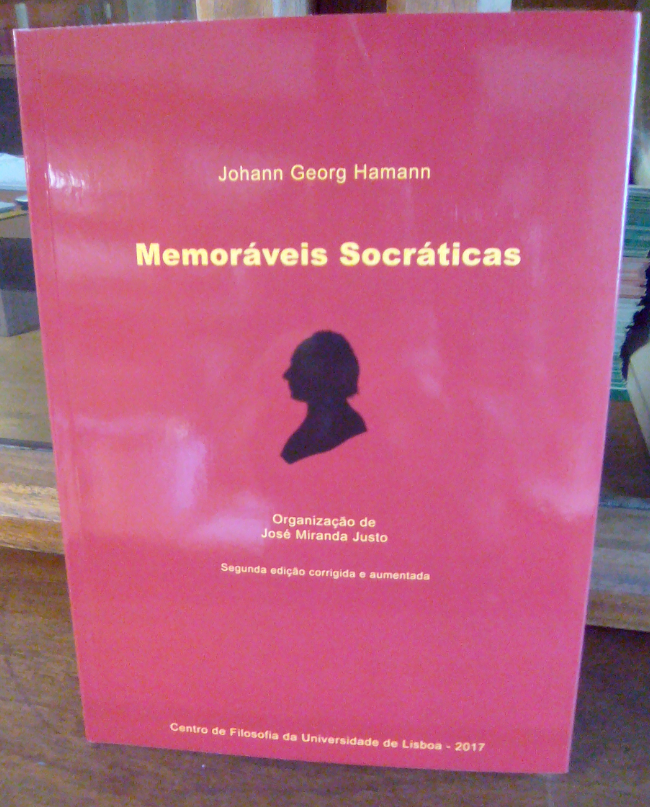
A segunda edição revista e aumentada do livro “Memórias Socráticas” de Johann Georg Hamann, tradução, notas, cronologia e posfácio de José Miranda Justo já se encontra disponível no Centro de Filosofia da Universidade de Lisboa.livromemoriassocraticas